Let's set the scene. I have a 1993 Civic EG hatch – shell is clean, no rust, freshly painted championship white, and it's begging for a heart transplant. I'm not building a drag car, not chasing a 10‑second quarter, and I don't care about dyno sheets that get posted on Instagram for likes. I want a car that I can drive 30 miles to work, blast through the mountains on weekends, and occasionally autocross – all while keeping a sane budget and not turning it into a trailer queen.
The two candidates that have occupied my mental real estate:
K24A2 – the 2.4L from the TSX (2004‑2008). 205 hp stock, 171 lb‑ft, i‑VTEC on intake and exhaust, revs to 7,000, loves boost, massive aftermarket.
J35A4 – the 3.5L V6 from the 2000‑2004 Acura RL / Honda Odyssey / Accord V6. 225‑240 hp stock, 240‑250 lb‑ft, SOHC with VTEC on intake, revs to 6,200, sounds like a snarling dog, practically zero aftermarket support for FWD swaps.
I've scoured forums, watched every YouTube video, and even sat in a couple of swapped cars at meets. But I want to dig deep into the daily driveability – because that's where these two engines diverge wildly.
Engine Character – The Intangibles
K24A2 – This is the refined, sophisticated choice. The i‑VTEC system allows cam phasing on both intake and exhaust, giving a flat torque curve from 2,500 rpm all the way to redline. It pulls cleanly, smoothly, almost like an electric motor. It's quiet, vibrations are minimal, and it's happy to cruise at 3,000 rpm on the highway. When VTEC crosses over at ~5,500, there's a gentle swell, not a violent kick. It feels like a premium Japanese sedan engine – which is exactly what it is.
J35A4 – The V6 is a brute. It makes peak torque below 3,000 rpm – 90% of its 240 lb‑ft is available by 2,500. That means you can lug it at 1,500 rpm in 4th gear and it'll pull without protest. The VTEC crossover (on the intake cam only) is audible – a deep, growling change in pitch that makes you grin. It vibrates more at idle (V6 imbalance), and it sounds like a mini‑V8 when you rev it out. The torque surge is addictive – it punts the car forward in a way that the K24 simply cannot match at legal speeds.
But here's the daily reality: that huge low‑end torque makes the car jumpy in stop‑and‑go traffic. You have to be delicate with the throttle, or the clutch takes a beating. The K24, with its linear delivery, is much easier to modulate in heavy traffic – you can creep along without feeling like you're about to lurch into the car ahead.
Power and Gearing – The Numbers
Stock dyno figures (corrected whp):
Engine | Stock WHP | Stock WTQ | Redline | Peak Torque RPM |
|---|---|---|---|---|
K24A2 | ~185 | ~155 | 7,100 | 4,500 |
J35A4 | ~200 | ~210 | 6,200 | 3,000 |
With basic bolt‑ons (intake, header, exhaust, tune):
Engine | WHP | WTQ |
|---|---|---|
K24A2 | 235‑245 | 185‑195 |
J35A4 | 250‑260 | 240‑250 |
The J35 has a clear torque advantage – about 50 lb‑ft more at the wheels. That's a massive difference in a 2,400‑lb EG. But gearing matters.
Transmission options:
K24 – Can mate to any K‑series transmission (5‑speed or 6‑speed). The common choice is the 6‑speed from the RSX Type‑S or Civic Si – close ratios, short final drive (4.76 or 5.06). This makes the K24 feel peppy and responsive.
J35 – Must use the J‑series transmission, which is only available from the Accord V6 (6‑speed manual, rare and expensive) or the automatic (not an option). The 6‑speed manual from the 2006‑2007 Accord V6 has a tall final drive (3.68) and wide ratios. That means the J35 feels less urgent in the first few gears, despite the torque. The gearing spreads out the power, so you don't get that snappy "throw you back" feeling – it's more of a long‑legged cruiser.
For daily driving, the K24 with the RSX 6‑speed is brilliantly matched – you're always in the powerband, and the short gearing makes the car feel alive at legal speeds. The J35 with its tall gearing feels like a grand tourer – relaxed on the highway, but less thrilling around town.
Installation and Packaging – The Nightmare Factor
K24 – Drop‑in friendly. There are dozens of swap kits (engine mounts, shift linkage, wiring harnesses) from companies like Innovative, Hybrid Racing, and HASport. The engine fits without cutting the frame rails or modifying the firewall. You can keep the factory hood latch. AC and power steering can be retained with the right brackets. The wiring is well‑documented – you can either buy a custom harness or modify the stock one with a pinout guide.
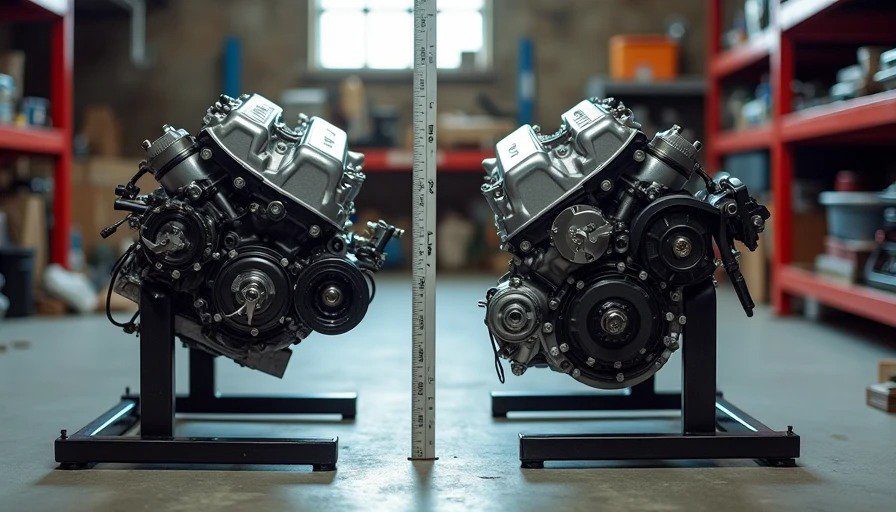
J35 – This is where things get ugly. The J35 is physically huge – it's 24" wide, 22" tall, and about 22" long (including accessories). In an EG engine bay, that means:
You must cut the front subframe / crossmember and fabricate a new one.
The steering rack needs to be relocated or modified (many people use a manual rack or a custom rack extension).
The hood won't close without a huge cowl – unless you drop the engine subframe an inch or two, which messes up suspension geometry.
The exhaust manifold is tight against the firewall – you'll need to hammer or cut the tunnel.
Wiring is a nightmare – there's no off‑the‑shelf harness; you'll be splicing the J35 ECU (which often has immobilizer) and integrating it with the EG's ancient body electronics.
AC and power steering are nearly impossible to retain without extensive custom fabrication.
The J35 weighs about 420 lbs dressed – the K24 is ~330 lbs. That extra 90 lbs over the front axle will ruin the EG's turn‑in and increase understeer. You'll need stiffer springs and a heavier front sway bar to compensate.
For a daily driver, the J35 install is a project within a project. Expect 3‑6 months of fab work, troubleshooting, and swearing. The K24 can be swapped in a long weekend with the right parts.
Costs – Realistic Budget
K24A2 swap (EG):
Engine + transmission + ECU + axles: ~$1,800‑2,200 (used)
Mount kit: $400
Wiring harness (custom): $500
Shifter linkage: $150
Intake, header, exhaust: $800
Tune: $500
Misc (hoses, fluids, hardware): $300
Total ~$4,500‑5,000 all in, running and driving.
J35A4 swap (EG):
Engine + 6‑speed manual (rare): ~$2,500‑3,000
Custom mounts: $600 (if you can find a kit, or fabricate yourself)
Subframe modification: $300 (materials) + labor if you don't weld
Custom header: $500
Wiring and ECU (with immobilizer delete): $1,000
Cooling (larger radiator, fans): $400
Fuel system upgrades (higher flow pump): $200
Hood modification: $200
Total ~$6,000‑7,500 – and that's assuming you don't pay for fabrication labor.
The J35 easily costs $2,000 more and takes 4× the time. For a daily driver, that's a hard pill to swallow.
Fuel Economy and Refinement
This is where the K24 runs away with it.
K24 – With the 6‑speed, expect 26‑28 mpg mixed driving, 32‑34 mpg highway. It's smooth, quiet, and doesn't drone.
J35 – Expect 18‑20 mpg mixed, maybe 24 highway. The V6 drinks fuel, especially when you're enjoying that torque. The engine also produces more heat, so your cooling system works harder – in stop‑and‑go summer traffic, you might need a larger radiator and extra fans.
Noise levels: the J35 is loud. The intake roar and exhaust note are intoxicating, but on a 45‑minute commute, it gets tiring. The K24 is whisper‑quiet at cruise.
The Emotional Decision
Despite all the pragmatic points, I can't shake the J35. Why? Because it's different. Every other swapped EG has a K20 or K24 – they're common, predictable, and a bit boring. The J35 transforms the car into something with genuine personality – it's the engine that Honda should have put in a hot hatch but never did. The way it sings, the way it shoves you back in the seat at 2,500 rpm, the sound of VTEC crossover on a V6 – it's intoxicating.
But for a daily driver, that novelty wears off when you're stuck in traffic, when your left leg aches from the heavy clutch, when you're filling up twice a week, and when you can't fit a grocery bag in the trunk because the custom exhaust takes up half the space.
My conclusion:
Choose the K24A2 if: You need a reliable, fuel‑efficient, fun daily that can also handle track duty. You want a smooth, linear power delivery that doesn't overwhelm the chassis. You value time and money over uniqueness. The K24 is the sensible, mature choice – and sensible is underrated.
Choose the J35A4 if: You're building a weekend toy, you have a second car, you love fabrication, and you're willing to sacrifice refinement for character. You want a car that people will gather around at a cars‑and‑coffee, and you don't mind the extra trips to the gas station.
For my personal EG, I'm leaning 80% toward the K24. I've done the "wild build" before with a turbo B‑series, and I spent more time wrenching than driving. This time, I want to actually enjoy the car every day. So K24 it is – but I'll always wonder what the J35 would have felt like.

No comments yet.