I'm going to say something that will get me banned from half the car groups on Facebook, but I've seen too many broken dreams to stay quiet: engine swaps are massively overrated for the average enthusiast.
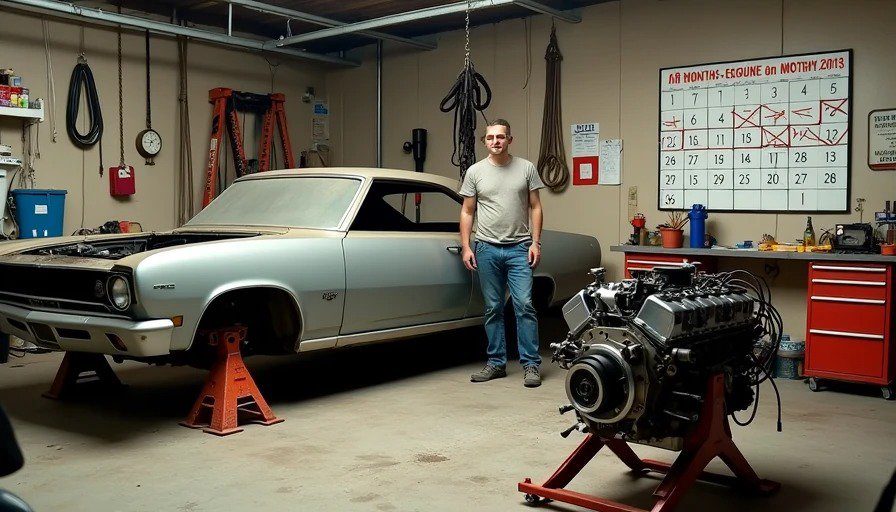
Look around your local car meet. I guarantee at least three people will tell you about their "LS swap project" that's been "almost done" for 18 months. They'll show you photos of the engine sitting on a pallet, the bare engine bay, and a pile of wiring harnesses that look like Medusa's hair. Then they'll tell you how they're "just waiting on a custom radiator" or "saving up for a standalone ECU." And when you ask when it'll run, they shrug and change the subject.
That's not a hobby – that's a hostage situation. Your car is held captive by your ambition, and you're paying the ransom in time and money.
Now, before you call me a Luddite, hear me out: I love the idea of a swapped car. An LS3 in a 240SX sounds like a riot. A K20 in an old Mini is engineering art. But for 90% of us – with day jobs, families, and a single‑car garage – the juice is not worth the squeeze. The smarter, faster, cheaper, and more satisfying path is to rebuild, cam, and tune the engine you already have.
Let me break down why, with hard numbers and real‑world experience.
The Swap Reality Check – Numbers Don't Lie
Time: A typical engine swap for a first‑timer takes 1‑3 years of intermittent work. I've seen builds drag on for five. The mechanical installation (mounts, driveshaft, exhaust) might take a few weekends, but then comes the wiring – which is a rabbit hole of pinouts, CAN bus, and immobilizer bypasses. Then cooling, fuel system upgrades, clutch hydraulics, and the inevitable "while I'm in there" scope creep. By the time it's done, you've lost all motivation and the car has become a chore.
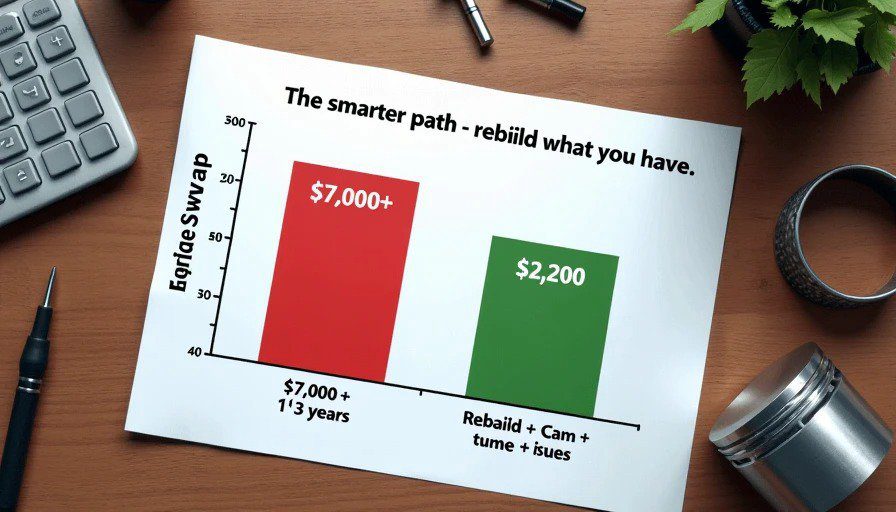
Cost: Let's do a conservative budget for a common swap – say, a K‑series into an EG Civic. Engine + trans (~$2,000), mounts ($400), custom harness ($500), ECU ($800), cooling ($300), exhaust ($600), fuel upgrades ($300), driveshaft mods ($200), and miscellaneous hardware ($500) – that's over $5,500 if nothing goes wrong. Add in a clutch, a tune, and shop labor for anything you can't do, and you're north of $7,000. And that's for a budget swap. An LS into an E36 or BRZ? Double that.
Reliability: Swaps are never as reliable as factory. You're mixing sensors, adapters, and aftermarket ECUs. You'll have cold‑start issues, check engine lights, and bizarre gremlins that only appear at 3,000 rpm on a rainy Tuesday. Even professional shops deliver cars that need "sorting out" for months.
The Alternative – Rebuild, Cam, Tune
Now let's look at what you can do with the engine that's already bolted between your frame rails.
Step 1 – Rebuild the bottom end. For most engines, a freshening with new rings, bearings, gaskets, and a mild hone is enough to restore compression and oil control. Cost: ~$500‑800 in parts, if you do the labor. If you pay a machine shop, maybe $1,500.
Step 2 – Install a performance camshaft. A mild street cam with higher lift and duration, paired with upgraded valve springs, can increase airflow by 15‑25%. For a Honda B‑series, a set of Skunk2 Tuner cams gives +20 whp. For a BMW M20, a 272 cam adds 15‑20 hp. For a Miata BP, a set of Maruha cams transforms the mid‑range. Cost: $300‑600 for cams, $200 for springs/retainers.
Step 3 – Bolt‑ons and tuning. A quality header, free‑flowing exhaust, and a cold air intake will help the engine breathe. Then a proper tune (standalone or flash tune) to dial in AFR and ignition timing – this is where the magic happens. A good tuner can unlock 20‑30 hp just by optimizing the fuel and spark maps for the new cam. Cost: $400 for intake/exhaust, $500‑800 for tuning.
Total investment: Roughly $2,000‑3,000, depending on how much you DIY. And the timeline? If you have a weekend to pull the engine, a week at the machine shop, and a weekend to reassemble, you can be driving within a month.
Results – real‑world examples:
My own E30 325i with an M20B25: stock 168 hp at the crank. I rebuilt the bottom end (new rings, bearings, oil pump), installed a Schrick 272 cam, an upgraded valve spring kit, a 6‑branch header, and a Miller MAF conversion with a War chip tune. The result? 195 whp (about 225 crank) – a 34% increase. The car pulls hard from 3,500 to 6,500, idles like stock, and I get 26 mpg on the highway. I spent $2,200 total and I've put 40,000 miles on it with zero issues.
A friend's NB Miata: stock 1.8L BP – 110 whp. He did a mild rebuild, a set of Maruha cams (264 duration), a Racing Beat header, and a Megasquirt tune. Ended up at 145 whp – that's a 32% bump. The car is a riot on back roads, and he drives it to work every day.
A Honda Civic with a D16 – people laugh at D‑series, but with a rebuilt bottom end, a Bisimoto cam, a ported head, and a Hondata tune, you can see 130‑140 whp from a 1.6L that originally made 100. That's enough to embarrass a stock Si, and it's dead reliable.
The common thread: none of these cars needed a different engine. They just needed the one they had to be treated with respect and given the right parts.
The Hidden Benefits – What Swaps Steal From You
Factory fit and finish. When you swap, you're inviting a host of packaging nightmares. The alternator may hit the hood, the steering rack may need to be moved, the brake booster may not clear the valve cover. You'll need custom AC lines, heater hoses, and often a new radiator. Suddenly your engine bay looks like a plumbing experiment, and you lose features you took for granted.
Gauges and electronics. On a swap, your factory tachometer, coolant temp gauge, and oil pressure light often become useless. You'll either install aftermarket gauges (which look out of place) or spend weeks with a CAN translator trying to make the original cluster work. With your original engine, everything plugs in – sensors, senders, and wiring are all matched. The dashboard behaves exactly as it should.
Resale value. A swapped car is a niche market. Most buyers are scared of unknown workmanship, lack of service history, and weird custom parts. A well‑built stock‑engine car with documented upgrades is far easier to sell – and often holds more value.
Emotional connection. There's something deeply satisfying about extracting every ounce of performance from the engine that your car was born with. It feels like you're completing the car's original vision, not replacing it. You learn the engine's quirks, its sweet spots, its sounds – and you appreciate its design.
The Excuses – and Why They're Weak
"My engine is too weak – it only makes 120 hp." – So does the Miata 1.6, and people love them. A 30% gain is still 36 hp, which transforms a lightweight chassis. And torque delivery can be improved dramatically with a cam and tune, often making the car faster in real‑world driving than a peaky swap.
"I want the sound of a V8." – Fair, but have you heard a well‑tuned inline‑6 with ITBs? Or a high‑revving 4‑cylinder with a proper exhaust? Sound is subjective, and your engine can sound amazing with the right headers and muffler. Plus, V8 swaps often require major exhaust routing that ends up muffling the very sound you wanted.
"I want turbo boost." – You can boost your original engine with a turbo kit, often cheaper and easier than a swap. A bolt‑on turbo for a Miata or Honda costs $2,000‑3,000 and gives 50‑100% power gains. Yes, there's tuning involved, but it's a far simpler path than swapping a whole new engine.
"I want to learn." – I respect that, but you'll learn more by rebuilding your engine – setting ring gaps, checking bearing clearances, degreeing a cam – than by bolting in a pre‑assembled long‑block with an aftermarket harness. The knowledge you gain is transferable, and you'll have a deeper understanding of internal combustion.
The One Situation Where Swaps Make Sense
I'm not a purist. There are legitimate cases for a swap:
Your original engine is known for catastrophic failure (e.g., early Subaru EJ25s with ringland issues).
You want to compete in a class that allows specific swaps for power/weight advantages.
You have a unique chassis that never came with a powerful engine (e.g., a Lotus 7 replica).
You have a dedicated race car with a support crew and a trailer.
But for a daily‑driven or weekend car? No. Rebuild, cam, tune.
My Challenge to You
If you have a project car right now with the engine sitting on a stand and the car up on blocks, ask yourself: When did I last drive this car? If the answer is more than six months ago, you've already lost. Now, imagine if you had spent that time rebuilding your original engine. You'd have been driving it for the past four months, grinning every time you hit the cam lobe.
I'm not saying swaps are stupid. I'm saying they're for people who have more time, money, and patience than they have common sense. For the rest of us, the smart move is to unlock the potential of what we already own. It's cheaper, faster, more reliable, and – most importantly – you'll actually enjoy your car this summer.
So before you click "Buy It Now" on that imported engine, take a hard look at the motor in your bay. It might surprise you.

No comments yet.