A serious 454 big block turbo kit setup and dyno results story starts long before the car reaches the rollers. The engine needs a realistic power target, a fuel system with room left in it, and exhaust plumbing that does not turn the engine bay into a furnace. This guide follows the decisions that matter when building a streetable big-block Chevrolet combination rather than chasing one spectacular pull.
Choosing the 454 foundation
The short block sets the ceiling for the entire project. A stock two-bolt 454 can support a mild turbo build when boost and rpm stay conservative, but an aftermarket block or properly prepared four-bolt casting gives more margin for detonation and cylinder pressure. For a street car, 8.5:1 to 9.5:1 compression is a useful range with modern cylinder heads and intercooling. Lower compression is not a substitute for a safe tune, though. Timing, fuel quality, intake temperature, and boost control still decide whether the engine lives.
A forged crankshaft, forged H-beam or I-beam rods, and forged pistons are sensible insurance once the goal moves beyond roughly 700 rear-wheel horsepower. The exact number depends on parts quality and the dyno, but the principle is simple: do not build the rotating assembly around the first boost number you plan to run. A 454 that makes 650 horsepower at 6 psi can become a very different engine at 12 psi, especially when traction improves and the motor sees sustained load.
Cylinder heads also deserve careful attention. Oval-port heads with a good valve job can work well on a torque-focused street combination, while large rectangular ports make more sense for high-rpm airflow. Use stainless turbo valves, strong springs, and a head gasket designed for the bore and boost level. Measure piston-to-valve clearance and verify quench instead of trusting a catalog description.
Matching the turbo kit to the goal
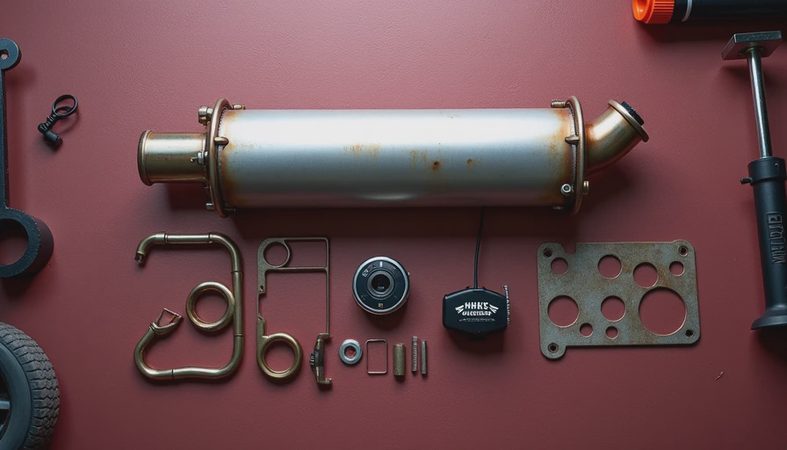
The most useful 454 big block turbo kit setup and dyno results come from a complete system, not a turbocharger chosen from a horsepower advertisement. A single 88 mm to 94 mm turbo can support a broad street range, but response, packaging, and exhaust backpressure differ significantly between turbine housings. A pair of smaller turbos can spool quickly and distribute exhaust flow, yet doubles the oil lines, wastegates, charge piping, and opportunities for leaks.
For a typical street-and-strip 454 targeting 800 to 1,000 horsepower at the crank, a properly sized single turbo with a divided or large single-scroll turbine is often easier to package. Use a 45 mm or 50 mm external wastegate, a quality blow-off valve, and a compressor inlet that does not collapse under suction. Schedule 10 or schedule 40 hot-side tubing is common in fabricated kits. Stainless tubing resists corrosion, while mild steel is easier to repair and often cheaper for a first version.
Do not ignore the wastegate placement. The gate needs a clean view of exhaust flow, not a sharp branch hidden behind the turbine inlet. Poor placement can create boost creep, where the engine continues making more boost than the controller commands. That problem is difficult to tune around and usually requires cutting the hot side apart.

Intercooling becomes increasingly important on pump gas. A front-mount air-to-air unit is straightforward for a street car, while an air-to-water system can reduce pipe length and fit better in a tight engine bay. Keep charge piping supported at the couplers, use rolled beads, and pressure-test the system before the first serious pull. A small leak can make a fuel map look wrong and send the tuner chasing a problem that is not inside the engine.
Fuel, ignition, and engine management
Fuel delivery is where many impressive-looking combinations fall short. An 800-horsepower turbo 454 can require more than 100 pounds per hour of fuel depending on fuel type, brake-specific fuel consumption, and injector duty cycle. Eight 1,000 cc/min injectors can work for some gasoline combinations, but E85 generally demands more injector and pump capacity. Twin pumps, a return-style regulator, large feed and return lines, and a stable fuel-pressure reference are easier to expand than a marginal single-pump system.
Use a fuel-pressure sensor connected to the ECU or a separate data logger. Injector pulse width alone cannot prove that the engine is receiving the fuel commanded by the calibration. Watch pressure under load, verify voltage at the pumps, and install filters that match the injector manufacturer’s requirements.
A crank trigger and coil-near-plug ignition usually provide more stable timing than a heavily modified distributor. The ECU should control timing, boost, rev limits, and safeties. Set conservative protections for lean air-fuel ratio, low fuel pressure, high coolant temperature, and excessive manifold pressure. A two-step limiter and launch control are useful, but they should not become excuses to ignore driveline stress.
What the dyno session should prove
A dyno sheet is only useful when the conditions and test method are documented. Record fuel type, tire pressure, correction factor, gear used, boost pressure, air-fuel ratio, ignition timing, inlet temperature, and coolant temperature. The phrase 454 big block turbo kit setup and dyno results should mean more than a peak horsepower screenshot. A clean torque curve and repeatable pulls tell you whether the combination is usable.
Start on wastegate spring pressure. On a typical 454, that might mean 5 to 7 psi for initial validation. Check for oil leaks, exhaust leaks, belt movement, fuel-pressure stability, and abnormal crankcase pressure before turning the boost controller up. Make changes in small steps, allowing the engine to return to a consistent temperature between pulls.
A realistic example might show 610 horsepower at the crank on spring pressure, followed by roughly 760 horsepower at 9 psi and just over 900 horsepower near 12 psi. Those figures are examples, not promises; turbo size, cylinder heads, fuel, and dyno type can move the result substantially. The useful observation is whether each boost increase produces predictable power without a sharp rise in exhaust backpressure or intake temperature.

Reading the data instead of chasing the peak number
The best 454 big block turbo kit setup and dyno results include the full log. Look for commanded versus measured air-fuel ratio, ignition timing, injector duty cycle, fuel pressure, boost, and manifold air temperature. A power curve that drops after peak torque can indicate turbine restriction, valve float, exhaust backpressure, or a tune that is pulling timing. More boost will not fix any of those issues.
Listen for detonation, but do not rely on your ears alone. Knock detection can be difficult on a large-displacement engine with forged pistons and valvetrain noise. Plug inspection, stable lambda readings, and repeatable timing data provide better evidence. Examine each plug for signs of uneven distribution, especially if the intake manifold or injector placement creates different conditions between cylinders.
If boost rises two pounds between 4,000 and 6,000 rpm without a controller change, the wastegate system may be too small or poorly positioned. If power changes dramatically between back-to-back pulls, investigate heat soak, fuel pressure, belt slip, or tire temperature before celebrating the higher number.
Finishing the street installation
Dyno success does not finish the build. Route turbo oil drains downhill with no low spots, shield brake lines and wiring from the turbine, and provide ventilation around the starter and steering shaft. A 3-inch or larger exhaust may be appropriate for a single turbo, but clearance and muffler design matter more than simply installing the largest pipe available.
Use a catch can with baffling, secure the intercooler mounts, and inspect header bolts after the first few heat cycles. Check transmission temperature and driveshaft angle as carefully as engine data. A 454 making 900 horsepower can expose weak U-joints, axles, clutches, and cooling systems very quickly.
Document every change: spring pressure, boost target, fuel pressure, timing, plug gap, and the exact fuel in the tank. That record turns a frustrating late-night diagnosis into a short troubleshooting session. Post the complete 454 big block turbo kit setup and dyno results, including the failed attempts and the re-dos. The numbers are valuable, but the process is what lets another builder make a better decision.

No comments yet.