I'm going to say something that will make the sponsors angry and the forum veterans nod slowly: Your $2,500 Wilwood or StopTech big brake kit is making you slower.
Not because the kit is bad—it's beautifully engineered. But because you installed it without doing the math on your car's hydraulic leverage, and now your brake pedal feels like stepping on a marshmallow, your ABS kicks in too early, and your brake bias has shifted rearward so your rear tires are doing work they weren't designed for. I've seen it on E30s, Miatas, 240SXs, and even on well‑built track Hondas. And I've been guilty of it myself.
This isn't a rant against big brakes. This is a call to understand the brake hydraulic system as a complete lever, not a bolt‑on fashion statement.
Let's start with the basics—the physics that most home builders skip.
Part 1: The Core Equation – What Actually Stops a Car?
The force that slows you down is tire friction, period. Brakes are just torque generators that convert hydraulic pressure into clamping force on a rotor. That clamping force creates a friction torque that decelerates the wheel. The limit is always the tire's grip—not the size of your rotors, not the number of pistons.
Stopping distance = function (tire friction, vehicle weight, brake torque, heat capacity)
Brake torque = (line pressure) × (piston area) × (coefficient of friction of pad) × (effective rotor radius)
Increase any of those, and you get more brake torque. But if that torque exceeds what the tire can handle, you lock up. That's where ABS saves you—but if the brake torque is wildly mismatched front to rear, ABS will be fighting itself.
So why do so many home builders overshoot?
Part 2: The Overlooked Hero – Pedal Ratio
Most people never measure their pedal ratio. Here's the definition:
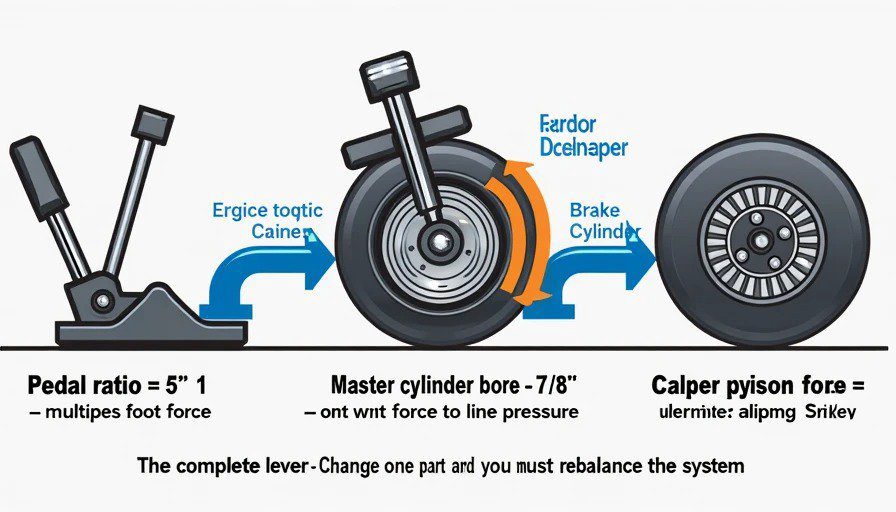
Pedal ratio = distance from pedal pivot to foot pad ÷ distance from pivot to master cylinder pushrod.
In most street cars, that number is between 4:1 and 6:1. The Miata NA/NB is about 4.5:1. An E30 is about 5:1. A modern BMW is around 6:1.
That ratio multiplies the force your foot applies. Push 50 lbs on the pedal, and if your ratio is 5:1, the master cylinder pushrod sees 250 lbs of force.
Now, the master cylinder converts that force into hydraulic pressure:
Line pressure = pushrod force ÷ master cylinder piston area (in square inches)
Let's say your master cylinder bore is 7/8" (0.875"). Area = π × (0.875/2)² = 0.601 sq. in. With 250 lb pushrod force → 250 / 0.601 = 416 psi line pressure.
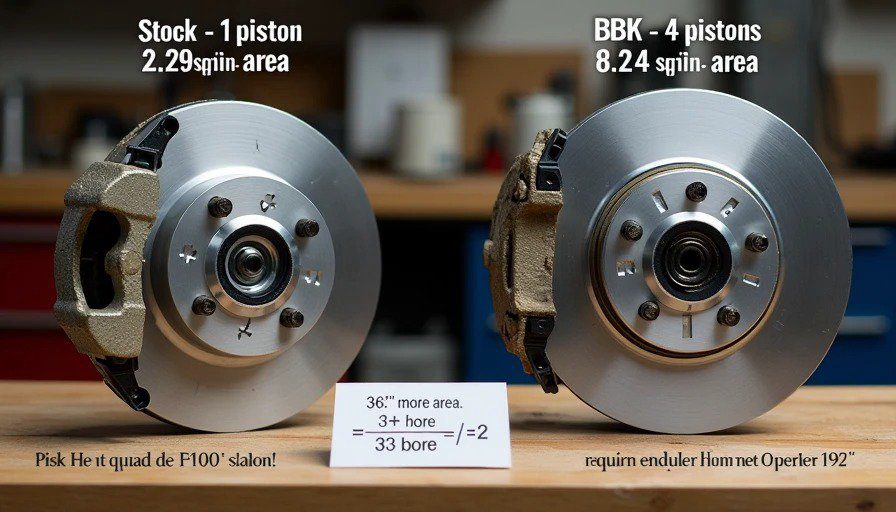
Now multiply that by the caliper piston area—for a stock single‑piston slider with a 2.0" piston, area = π × (1.0)² = 3.14 sq. in. Clamping force = 416 × 3.14 = 1,306 lbs per front caliper.
Now install a 4‑piston Wilwood with four 1.5" pistons. Total area = 4 × (π × 0.75²) = 4 × 1.767 = 7.07 sq. in.—more than double.
If you keep the same master cylinder and pedal ratio, line pressure drops? No—line pressure stays the same because you're still pushing the same master cylinder. But the clamping force doubles to 416 × 7.07 = 2,941 lbs. That's 2.2× the brake torque for the same pedal effort.
That sounds like a good thing—until you realize you now need to modulate that force with a pedal that requires about half the travel to generate the same torque. The pedal becomes over‑assisted, hypersensitive, and you lose fine control near the limit. Your threshold braking window shrinks from 50 lbs of pedal‑force variation to maybe 15 lbs. You're more likely to lock and trigger ABS earlier.
Part 3: The Bias Problem – Who's Stopping Whom?
Your car's brake bias (front/rear split) is fixed by the hardware. Stock proportioning valves and master cylinder sizing are tuned for the factory piston areas.
When you increase front piston area by 100%, but leave the rear brakes alone, you've just shifted bias forward—more front brake torque. But wait: you also changed the volume of fluid needed to move the front pads. Larger calipers require more fluid to displace the same pad movement. With the same master cylinder bore, that means your pedal travel increases.
So now you have two bad effects:
More pedal travel before the pads contact
Much higher front brake torque per inch of travel
Rear brakes doing less work because they activate later (due to the larger front volume)
End result: a car that feels "grabby" at the top, but vague when you need to trail‑brake, and longer stopping distances because the rear tires aren't contributing their share.
Part 4: Real‑World Test – My E36 Before and After
I ran this exact experiment on my own E36 328i track car.
Stock setup:
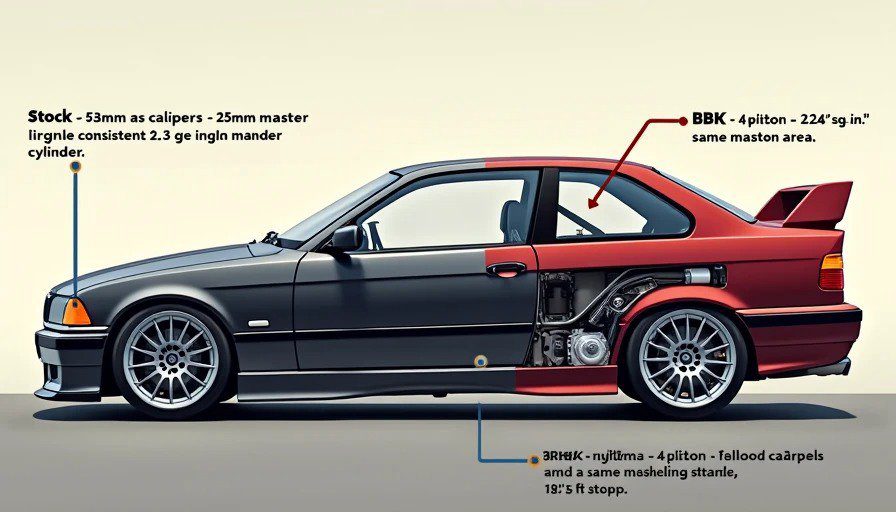
Master cylinder: 25mm bore (0.984")
Front calipers: single‑piston 54mm sliding
Rear calipers: single‑piston 40mm sliding
Pads: Hawk HP+ front, stock rear
Tires: 245/40R17 Michelin Pilot Sport 4S
50‑0 mph stops (average of 5): 112 ft – consistent, with good pedal feel, and ABS intervention only on the last 10 ft.
Then I installed a "budget" BBK:
Front: Wilwood Dynalite 4‑piston, 1.62" pistons (total area 8.24 sq. in., nearly 3× stock)
Used the same master cylinder
Rear: stock (I didn't upgrade the proportioning valve)
Same pads, same tires, same day
Results:
Pedal travel increased by 1.5 inches before engagement
The pedal felt "spongy" even after bleeding with Motul RBF600
50‑0 stops averaged 118 ft – 6 feet longer
ABS cut in hard and early, especially on the front wheels
Rear brakes were barely warm after hard stops (no rear bias)
What happened? The increased front piston volume ate up master cylinder stroke, delaying rear brake activation. And the proportioning valve was still set for stock bias, so the rear line pressure was limited while the front was now overpowered. The front tires locked earlier, ABS backed off, and total deceleration dropped.
I then swapped to a 28mm master cylinder (from a 750iL) and added an adjustable proportioning valve. That restored pedal travel and bias, and the 50‑0 dropped to 109 ft – actually better than stock, but only after I re‑engineered the whole system.
The cost? BBK ($1,000), custom lines ($150), new master ($200), valve ($80), plus two track days to dial it in. Total > $1,500 to gain 3 feet.
Part 5: What Actually Works – The Budget Physics‑Based Approach
Instead of throwing money at calipers, here's the home‑builder's correct order of operations:
Measure your pedal ratio. It's free. If you can lengthen the pedal arm (add a pedal extender) or move the pushrod attachment point, you can increase leverage—more force with less travel. Some racers weld a new pushrod hole 1/2" lower on the pedal—instant 15% improvement in leverage.
Match master cylinder bore to caliper piston area. There's a formula: the total caliper piston area ÷ master cylinder area should stay within the factory range. If you double caliper area, you must double master cylinder area to keep the same pedal travel and pressure. Use a larger master cylinder—it's cheap ($100‑200).
Upgrade pads first. A good set of track pads (e.g., Carbotech XP10, PFC 08, or Hawk DTC‑60) will increase friction coefficient from 0.35 to 0.55—a 57% increase in clamping force for $200. That's more gain than a BBK without the hydraulic headaches.
High‑temp fluid and stainless lines. For $150, you'll get consistent pedal and no fade. This is where 90% of "brake fade" complaints actually come from—boiling fluid, not undersized rotors.
Only upgrade rotors for heat capacity. If you're overheating stock rotors on a track, go for a larger diameter rotor with the same caliper piston area (using a bracket adapter) and keep the stock caliper. This increases rotor radius (more torque) and thermal mass—without changing hydraulics.
Part 6: The "Change My Mind" Challenge
So here's my challenge to everyone who's installed a BBK without touching the master cylinder:
Calculate your new caliper piston area (all pistons on one side of the rotor—for a sliding caliper, it's the area of the piston; for a fixed, it's half the total).
Calculate your original area.
If the new area is more than 30% larger, you must increase master cylinder bore proportionally.
Did you? If not, post your pedal travel measurement before and after.
I'll bet most of you haven't.
Now, some will say: "But my pedal feels great!" — and that's fine. Pedal feel is subjective. But the physics says your brake torque distribution is off unless you rebalanced it. You might be comfortable with the new feel, but your car is leaving stopping distance on the table.
I'm not saying "big brakes are bad." I'm saying "big brakes without math are a downgrade."
If you've got data—actual 60‑0 distances, or pedal‑force measurements, or a bias calculation—I want to see it. I'll happily admit I'm wrong if you can show me a car that stops shorter with an oversized caliper and no matching master cylinder.
But from my testing, from the race shops I've talked to, and from the engineering textbooks: the stock system, properly serviced and with a tweaked pedal ratio, will beat a mismatched BBK every time.
What I Run Now
After my experiment, I returned to a nearly stock setup on my E36:
Stock 54mm front calipers, rebuilt with stainless pistons
Stock 40mm rear calipers
25mm master cylinder (stock size) because I kept stock piston area
PFC 08 pads front, Hawk HP+ rear
Stainless lines, Motul RBF600
An adjustable proportioning valve dialed to 57% front bias (stock was 65%)
And I lengthened the pedal pushrod hole by 5/8" to get a 5.5:1 ratio
The car stops on a dime, the pedal is firm, and I can threshold brake with my eyes closed. I spent about $450 total (pads, fluid, lines, valve, and a junkyard pedal). I've done 20 track days and have never boiled the fluid—and I'm not a slow driver.

No comments yet.