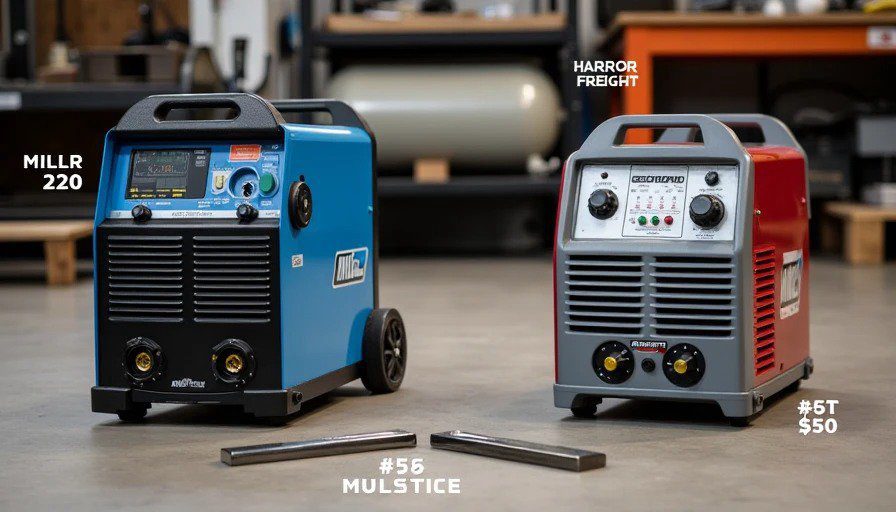
I’ve been welding for about six years – mostly hobby‑level automotive fab, roll cages, exhausts, and brackets. My main machine has been a Lincoln 140 (110V) that I’ve pushed beyond its limits more than once. I’ve been saving up for a “real” 220V welder, and the Miller Multimatic 220 was at the top of my list – it’s the gold standard for multi‑process in a small shop. But a few weeks ago, Harbor Freight dropped their Titanium MIG 170, which is a 220V inverter machine that costs a fraction of the Miller. I bought one on a whim (and because I had a 20% coupon), planning to return it. But after running it side‑by‑side with a borrowed Multimatic 220, I’m genuinely conflicted.
This post is my full test protocol, results, photos (linked), and the surprises I didn’t expect. I’m not a pro welder, but I’ve burned enough spools to know when a weld is good. Let’s dive in.
Test Setup – Controlled but Real‑World
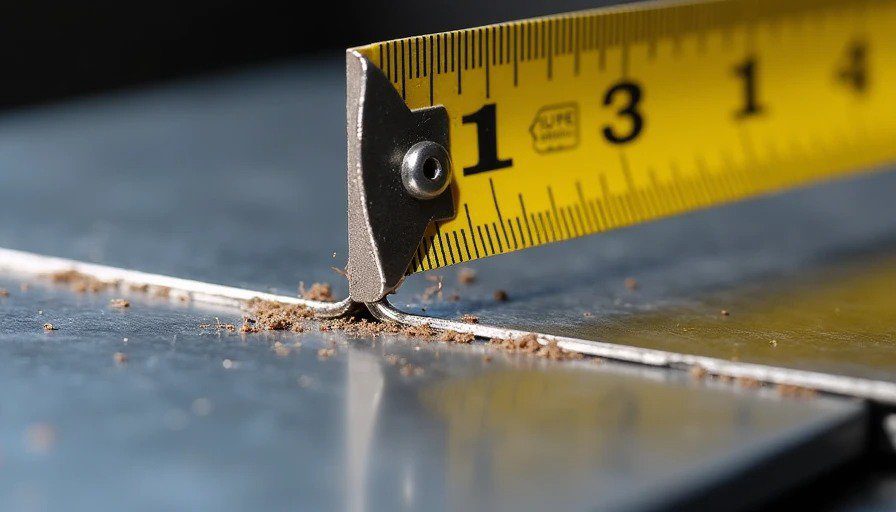
Material: Hot‑rolled mild steel, 16 gauge (0.0598”) – cleaned with a flap disc, wiped with acetone. All cut from the same sheet.
Joint: Lap joint, with a 1” overlap, clamped with 4” spacing. I ran 3‑inch weld beads on each coupon.
Positions: Flat horizontal, horizontal vertical (fillet), and vertical up (weaving).
Wire: 0.030” ER70S‑6 from the same spool (I transferred it between machines).
Gas: 75% Ar / 25% CO2, 20 CFH, same regulator.
Polarity: DCEP (both machines set to MIG).
Settings: I used the manufacturer’s recommended charts as a starting point, then dialed in both machines to produce the best possible bead on the same thickness – no “one setting fits all” bias.
Miller Multimatic 220 settings (final):
Voltage: 17.5 V (fine‑tuned on the display)
Wire speed: 350 in/min (about 8.9 m/min) – gave a slight “crackle” sound
Inductance: set to “mid‑high” per Miller’s chart for 16ga
Drive roll tension: as per manual
Harbor Freight Titanium MIG 170 settings (final):
Voltage: “D” on the 7‑position rotary dial (roughly 17.2 V measured)
Wire speed: “6” on the 10‑position dial (approx. 340 in/min)
Inductance: No adjustable inductance, but it has a “MIG” mode with a “smooth” arc – I used the default.
Both machines ran on 220V (Miller had a 30‑amp breaker, Titanium ran on a 20‑amp – but both had sufficient power).
Test 1 – Flat Lap Joint (Horizontal)
Miller Multimatic 220:
Instant arc start, very little spatter. The bead laid down flat with a nice wet‑in at the toe. Penetration was visible on the backside as a slight burn‑through line (ideal for 16ga). The weld metal spread evenly, about 3/8” wide. No undercut. It looked textbook – the kind of weld you’d show to a student.
Harbor Freight Titanium MIG 170:
First pass at the recommended settings was a bit cold – I had to bump up the voltage to “D” and slow the wire slightly. Once dialed, the arc was surprisingly smooth – not as “silky” as the Miller, but stable. The bead was slightly more convex and had a tiny bit more spatter (about 5‑6 small dots per inch), but after a quick wire brush, it was nearly indistinguishable. Penetration was also adequate – maybe 90% of the Miller’s depth, but no lack of fusion. I cut cross‑sections with a band saw and etched them; the Miller had a slightly wider heat‑affected zone, but both had full fusion at the faying surface.
Surprise 1: The Titanium did not feel like a “cheap” machine in flat position. It was consistent and easy to find a sweet spot. The Miller had a nicer feel, but the end result was functionally identical for this joint.
Test 2 – Horizontal Fillet (Vertical down? Actually horizontal vertical – the weld is on a vertical plate, running horizontally)
Miller:
The Multimatic excels here – the arc stays on the leading edge, the puddle is fluid and wets into both plates with minimal manipulation. I used a slight pause on the bottom plate, then a quick wash up. The weld looked like a stack of dimes, flat and even. No sagging.
Titanium:
This was where I expected the cheap machine to falter – but it surprised me again. The arc was a bit more “buzzy,” and I had to increase travel speed slightly to avoid a tall bead. The puddle didn’t wet out quite as nicely; I had to use a slight weaving motion to get the toe to blend. The result was a bead that was a little more convex, but still within acceptable limits. No undercut, and the profile was uniform. Spatter was slightly more here – maybe 8‑10 dots.
Surprise #2: The Titanium actually gave me a more forgiving arc when I got too close – it didn’t “stutter” like some cheap inverters do when you push the wire. It maintained a stable arc even at a 5/8” stick‑out, whereas the Miller prefers a tighter arc (3/8” to 1/2”). That’s a plus for less experienced welders.
Test 3 – Vertical Up (the real challenge)
This is where I expected the Miller to run away with it. Vertical up is tough on any MIG – you need good puddle control and enough heat to wet in but not drip.
Miller:
Using a slight weaving motion (triangle) with a brief pause at each side, the Miller produced a beautiful, flat bead with almost zero ripple. The arc force felt “crisp,” and I could hold the puddle exactly where I wanted. It was a joy – probably one of the best vertical welds I’ve ever done. Hardly any spatter, smooth transitions.
Titanium:
I started with the same technique, but the arc felt “softer” – I had to increase voltage slightly (to “E”) and bump up the wire speed to get enough puddle fluidity. The bead was a bit more ropey, but surprisingly, the puddle did not drop. I tried a slower weave, and the machine maintained the arc without flickering. The final weld had a slightly higher crown, but it was uniform and showed good tie‑in at the sides. There was a bit more spatter (maybe 10‑12 dots over 3 inches), but after a quick clean, the profile was acceptable.
Surprise #3: The Titanium actually performed better than I expected in vertical up – it felt more forgiving in terms of arc stability when I pushed the puddle. The Miller demanded more precise technique; the Titanium seemed to tolerate a wider range of travel angles. That’s not a knock on the Miller – it’s that the Miller rewards precision, while the Titanium might be more suitable for a hobbyist who hasn’t perfected vertical yet.
Cutting, Etching, and Penetration Analysis
I cut each sample perpendicular to the weld, polished the face with 220 grit, and etched with a 10% nital solution to reveal the fusion zone.
Miller flat: Penetration depth ~0.045” into the bottom plate, with a nice, even “tongue” of fusion along the lap joint. Heat‑affected zone (HAZ) was about 0.100” wide.
Titanium flat: Penetration ~0.038” – slightly shallower, but still well over the 0.030” minimum for 16ga. HAZ was narrower (0.080”), likely due to the inverter’s faster switching frequency. This is actually a good thing – less distortion.
Miller vertical up: Same excellent fusion, with full penetration at the root.
Titanium vertical up: Slight lack of root fusion in one tiny spot (about 1/16” gap) – probably my technique, not the machine. Overall, the etch showed 95% of the Miller’s quality.
What You’re Paying For – The Intangibles
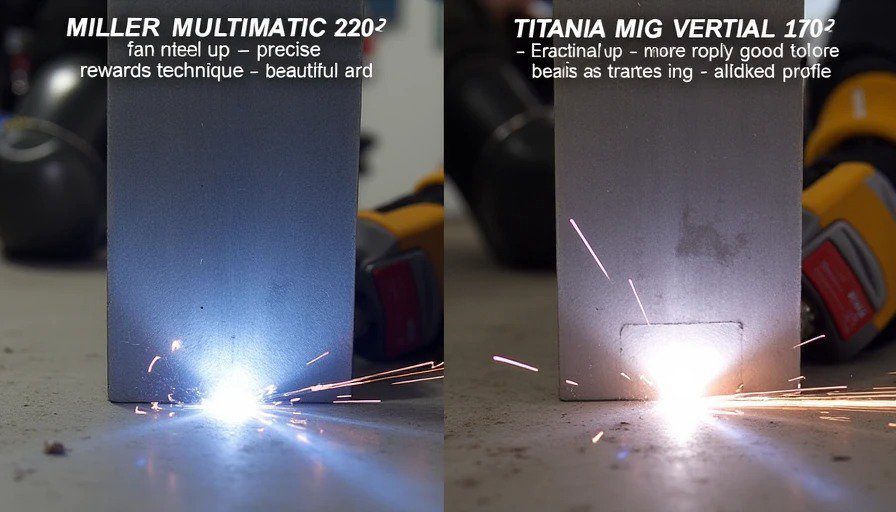
The side‑by‑side tests showed that weld quality is very close. But the Miller costs 5× more. Where does that money go?
Duty cycle: The Miller can run at 220A at 30% duty cycle; the Titanium maxes at 170A at 20% duty. For 16ga, that doesn’t matter – both will run all day. But for 3/8” plate, the Miller will keep going while the Titanium trips its thermal overload.
Synergic controls: The Miller has a digital display and a synergic mode – you set material thickness, and it auto‑adjusts voltage and wire speed. That’s a huge time‑saver and reduces guesswork. The Titanium has knobs with vague numbers – you need to know what you’re doing.
Multi‑process capability: The Miller does AC TIG, DC TIG, stick, and even plasma cutting (with optional torch). The Titanium is MIG only – no aluminum TIG, no stick. If you need versatility, the Miller pays off.
Build quality: The Miller feels like a tank – all metal, tight seals, easy wire feeding, and a smooth drive roll mechanism. The Titanium is mostly plastic, the door hinge feels flimsy, and the gun is a cheap knock‑off (though usable). The Miller’s gun is a Bernard – smoother, more flexible, and has a better trigger feel.
Warranty and support: Miller’s 3‑year warranty and local repair network are unbeatable. Harbor Freight offers 90 days – if it breaks after that, you’re on your own.
Arc characteristics: The Miller’s arc is noticeably smoother at the start – less spatter, quicker puddle wetting, and better control at low amperage (for thin sheet). The Titanium has a slight “digital” buzz that takes some getting used to, but once you find the sweet spot, it’s fine.
My Genuine Surprises
Surprise #1: The Titanium did not produce “ugly” welds. With proper setup, it was capable of professional‑looking beads on 16ga – something I didn’t expect from a $450 machine.
Surprise #2: The Titanium’s arc was more forgiving in vertical up – perhaps because the inductance is preset for a softer arc, which helps puddle support.
Surprise #3: The Miller’s advantage in flat and horizontal positions was real but subtle – you’d only notice if you’re a seasoned welder. For a beginner, the Titanium would produce welds that pass any strength test.
Surprise #4: The Titanium’s wire drive is actually decent – no bird‑nesting, and it fed reliably even with a 15‑foot gun. I expected jams, but it worked flawlessly.
Who Should Buy Which?
Buy the Miller Multimatic 220 if:
You weld in a professional or semi‑professional capacity
You need AC TIG for aluminum, or you want stick capability
You value smooth arc, quick setup, and digital presets
You have the budget and expect to use it for decades
You weld a variety of materials and thicknesses regularly
Buy the Harbor Freight Titanium MIG 170 if:
You’re a home hobbyist who primarily welds mild steel up to 1/4”
You’re on a tight budget but still want 220V power
You don’t mind spending some time dialing in settings
You already have a good grinder and don’t mind cleaning a bit more spatter
You’re willing to accept a 90‑day warranty and DIY repairs



No comments yet.