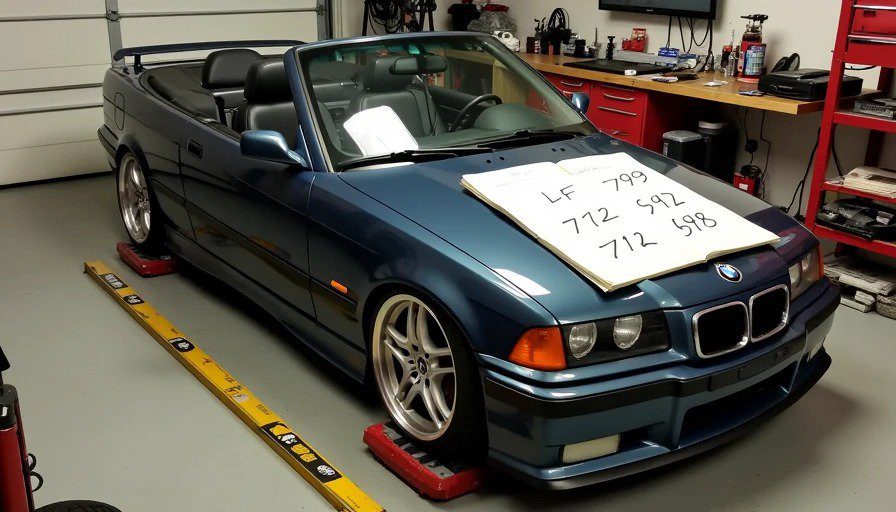
I've been tracking my E36 M3 for about three years now. It's a dedicated HPDE car – stripped interior, AST 5100 coilovers, spherical bearings everywhere, a half-cage, and a stock S52 that just won't die. I've chased lap times with tires, pads, alignment, and even aero. But I'd never corner-balanced it. Why? Because I didn't have scales, and I kept telling myself "it's close enough."
Spoiler: it wasn't.
Last month, a friend from the forum lent me his Longacre scales for a weekend. I cleared out my garage, found the flattest spot on the concrete (which took an hour with a 4-foot level and some shims), and spent an entire Saturday weighing, adjusting, re-weighing, and swearing. Then I took the car to Road Atlanta for a two-day HPDE with Just Track It-. The before/after data was staggering – not just in lap times, but in how the car felt and what that revealed about my driving habits.
This is my full write-up – for anyone who's been putting off corner-balancing because it seems intimidating or unnecessary. Trust me: it's the best $0 (if you borrow scales) you'll ever spend on your car.
Part 1: The "Before" – A Car That Lied to Me
I thought my car was balanced. I'd set ride heights by measuring from the fender lip to the hub – all four corners within 1/8" of each other. I'd done alignments with string and a camber gauge. The car felt "fine" on track – a little pushy in right-handers, a little loose in lefts, but I chalked that up to Road Atlanta being a clockwise track with more right turns.
Then I put it on the scales.
Before corner-balance – with me (185 lbs) in the driver's seat, full tank of gas:

Corner | Weight (lbs) |
|---|---|
LF (Left Front) | 798 |
RF (Right Front) | 712 |
LR (Left Rear) | 692 |
RR (Right Rear) | 648 |
Totals:
Total weight: 2,850 lbs
Front weight: 1,510 lbs (53.0%)
Rear weight: 1,340 lbs (47.0%)
Left weight: 1,490 lbs (52.3%)
Right weight: 1,360 lbs (47.7%)
Cross-weight (LF + RR): 798 + 648 = 1,446 lbs → 50.7%
Wait, that doesn't look terrible. 50.7% cross is within the "close enough" range that many forum posts call acceptable-. So why did the car feel wrong?
Because cross-weight is only half the story. Look at the individual corners:
LF is 86 lbs heavier than RF – that's a massive imbalance on the front axle.
LR is 44 lbs heavier than RR.
That means the car was carrying a huge amount of weight on the left-front tire – the outside front in a right-hand turn. In a right-hander, that tire would get overloaded, push wide, and understeer. In a left-hander, the right-front was underloaded, so the car would rotate too easily and oversteer.
The car wasn't "balanced" – it was a mess. It just felt "fine" because I'd learned to drive around its quirks.
The target for most track cars is 50% cross-weight with the driver in place-. For road racing on a circuit with both left and right turns, you want the left and right weight percentages as close to 50% as possible-. My left weight was 52.3% – that's a 4.6% bias to the left, which explains why the car turned better one way than the other-.
Part 2: The "After" – Three Hours of Adjusting, Six Beers, and One Revelation
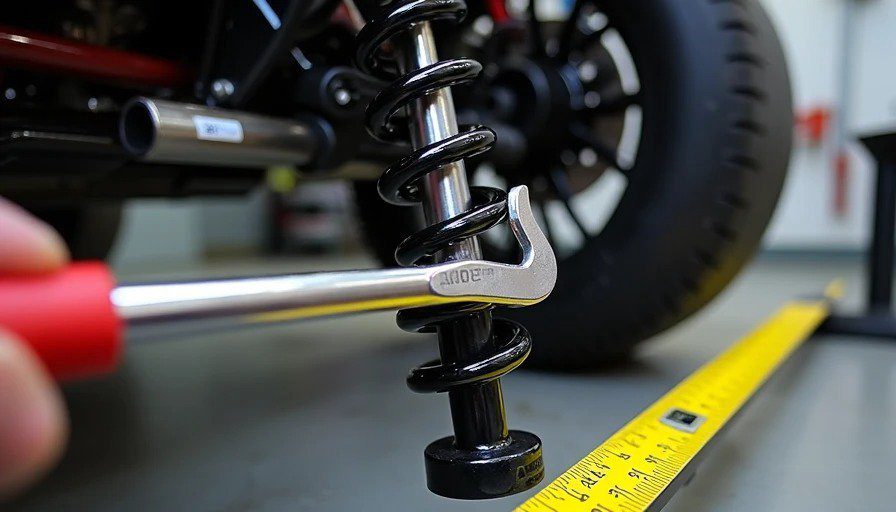
Corner-balancing is simple in theory: you adjust the spring perches on your coilovers to shift weight diagonally. Raising a corner transfers weight to the opposite diagonal; lowering a corner does the reverse-.
The process:
Roll the car onto the scales (with driver, full fuel, and all gear you run on track).
Record weights.
Calculate cross-weight percentage.
Adjust spring perches – if cross is too high, raise LF and RR or lower RF and LR-.
Roll the car off, bounce the suspension, roll back on, and re-weigh-.
Repeat until you hit your target.
I did this about 15 times. Each adjustment changed ride heights, so I had to re-measure and re-level. It was tedious, frustrating, and absolutely worth it.
After corner-balance – target 50% cross, with me in the seat:
Corner | Weight (lbs) | Change |
|---|---|---|
LF | 762 | -36 lbs |
RF | 748 | +36 lbs |
LR | 678 | -14 lbs |
RR | 662 | +14 lbs |
Totals:
Total weight: 2,850 lbs (unchanged)
Front weight: 1,510 lbs (53.0% – unchanged)
Rear weight: 1,340 lbs (47.0% – unchanged)
Left weight: 1,440 lbs (50.5% – down from 52.3%)
Right weight: 1,410 lbs (49.5% – up from 47.7%)
Cross-weight (LF + RR): 762 + 662 = 1,424 lbs → 49.96%
The cross-weight was now dead-on 50%. But more importantly, the left-right split was nearly even – 50.5% left vs. 49.5% right. The car would now turn equally in both directions.
The ride heights changed:
LF: dropped 3/16"
RF: raised 1/8"
LR: dropped 1/8"
RR: raised 3/16"
Nothing dramatic – less than 1/4" of adjustment at any corner. That's how sensitive these cars are.
Part 3: The Track – Road Atlanta, Before and After
Road Atlanta is a 2.54-mile, 12-turn clockwise circuit with 79 feet of elevation change-. It's fast, technical, and rewards commitment – especially through the Esses and the downhill plunge into Turn 12-.
I ran the car on the same setup both weekends:
Tires: Hankook RS-4 (same set, 8 heat cycles)
Brake pads: PFC 08 (same set)
Alignment: unchanged (I didn't touch it during the corner-balance)
Before corner-balance – best lap: 1:46.2
The car felt busy. In right-handers, the front would push wide – I'd have to wait for the car to take a set before I could get back on throttle. In left-handers, the rear would step out unexpectedly, especially at Turn 5 (the left-hander after the Esses). I was driving defensively, never fully trusting the car.
After corner-balance – best lap: 1:44.8
That's a 1.4-second improvement from a setup change alone. No new tires, no more power, no aero – just weight distribution.
But here's the thing: the lap time doesn't tell the whole story. The car was now predictable. I could brake later, turn in harder, and get on throttle earlier because I knew what each corner of the car would do.
Part 4: What the Numbers Taught Me About My Driving
This is the part that surprised me most. The corner-balance didn't just fix the car – it exposed my bad habits.
Lesson 1: I was over-slowing for Turn 7 because I didn't trust the front.
Turn 7 at Road Atlanta is a slow right-hand hairpin that leads onto the long back straight-. Exit speed here is everything – if you're slow out of 7, you lose time all the way down the straight.
Before the balance, I was braking early and trailing off too slowly because the front would push if I carried too much speed. The LF was 86 lbs heavier than RF – that outside front tire was overloaded in right turns. No wonder it pushed.
After the balance, the front was nearly equal (762 vs 748). I could brake 15 feet later, rotate the car on entry, and get back to full throttle 20 feet earlier. My exit speed at Turn 7 jumped from 82 mph to 86 mph – and that carried all the way down the straight.
Lesson 2: I was late on the throttle at Turn 12 because I didn't trust the rear.
Turn 12 is the famous downhill right-hander that leads onto the front straight-. It's a blind, compression-heavy corner that demands balls and precision-.
Before the balance, the rear would get light and twitchy on the compression because the left-rear was carrying too much weight (692 vs 648). The car would oversteer unpredictably, so I'd wait until I was practically pointed straight before getting back on power.
After the balance, the rear was more balanced (678 vs 662). The car stayed planted through the compression, and I could roll into the throttle 50 feet earlier – right at the apex instead of after it. That gained me 0.4 seconds alone.
Lesson 3: I was driving around the problem, not fixing it.
This is the biggest takeaway. For three years, I'd been adapting my driving to a broken car. I'd developed habits – braking early, waiting on throttle, avoiding certain curbs – that were compensations for the car's imbalances. I thought I was being "smooth" and "patient." I was actually being slow.
The corner-balance didn't just make the car faster – it made me a better driver because it removed the excuses. Now when I'm slow through a corner, I know it's me, not the car.
Part 5: The Numbers That Matter Most
Here's the full before/after data:
Metric | Before | After | Change |
|---|---|---|---|
Cross-weight | 50.7% | 49.96% | -0.74% |
Left weight | 52.3% | 50.5% | -1.8% |
LF vs RF difference | 86 lbs | 14 lbs | -72 lbs |
LR vs RR difference | 44 lbs | 16 lbs | -28 lbs |
Best lap time | 1:46.2 | 1:44.8 | -1.4 sec |
Turn 7 exit speed | 82 mph | 86 mph | +4 mph |
Turn 12 throttle point | After apex | At apex | ~50 ft earlier |
The lap time improvement is real, but the consistency improvement is even bigger. Before the balance, my lap times varied by 1.5 seconds from lap to lap. After, they varied by 0.4 seconds. The car was now repeatable – I could push lap after lap without fighting it.
Part 6: What I Learned for Next Time
Always corner-balance with the driver in the car. My weights changed by nearly 100 lbs with me in the seat. Balancing an empty car is pointless-.
Get the surface perfectly level. I used shims and a 4-foot level – any slope throws off the readings-. Cheap linoleum tiles worked great for shimming-.
Roll the car and bounce it after every adjustment. Suspension stiction (friction in the bushings and shocks) will give false readings if you don't settle the car-.
Don't chase perfection. Some forum posts argue that 50% cross-weight is just a starting point – you might want a slight bias for a particular track-. For Road Atlanta, which has more right turns, a tiny bias to the right might actually help. But I'm happy with 50% for now.
Corner-balancing won't fix a fundamentally broken suspension. If your springs are wrong, your shocks are blown, or your bushings are shot, scales won't save you. Get the mechanicals right first.
Part 7: The Verdict – Should You Do It?
Absolutely. Even if you don't have access to expensive scales, there are DIY methods using bathroom scales and lumber-. The results are "good enough" for most enthusiasts-.
The corner-balance transformed my car from something I managed into something I drove. It gave me confidence, consistency, and a 1.4-second lap time drop – all from adjusting spring perches by less than 1/4 inch.
But the real value wasn't the lap time. It was the revelation that I'd been driving a broken car for three years – and that fixing it made me a better driver, not just a faster one.
If you're on coilovers and you've never corner-balanced your car, do it. Borrow scales, bribe a friend with beer, and spend a Saturday in the garage. Your lap times will thank you – and so will your driving.
No comments yet.