An e30 skid plate is one of those parts that seems unnecessary until a sharp rock, deep rut, or misplaced jack stand turns a clean project into an expensive repair. The BMW E30 has good ground clearance for a street car, but lowered suspension, aggressive driving, gravel roads, and imperfect ramps change the equation quickly. A properly designed e30 skid plate protects the oil pan, steering components, exhaust, and other vulnerable hardware without turning the underside into a heavy, rattling mess.
For a long-term build, this is not just about buying the thickest plate available. Fitment, material, mounting points, service access, and actual ride height matter more than a dramatic product photo. Start with your chassis code, engine, transmission, oil pan, and suspension setup. An early 318i, an M20-swapped 325i, and an S52-swapped track car can all need different coverage.
What an e30 skid plate should protect
The most important job of an e30 skid plate is to spread an impact across stronger mounting points rather than letting one object hit a thin aluminum oil pan. On an M20 car, the oil pan is a common concern because it sits low and can be damaged by a rock or abrupt contact with a road surface. An M42, M50, or S52 swap changes the shape and location of the vulnerable areas, so do not assume one plate fits every engine bay.
A useful plate usually extends from the front subframe toward the rear of the engine or transmission area. It should shield the oil pan and provide a smooth leading edge that slides over obstacles instead of catching them. Some designs also protect the steering rack, sway bar, and front section of the exhaust. Full-length rally-style coverage can be valuable on a gravel car, while a shorter street plate may be the better choice for a low E30 that only needs oil-pan insurance.
Mounting matters as much as coverage. Avoid relying on thin sheet metal or random self-tapping screws. A solid design uses existing subframe, crossmember, or frame mounting points and spreads the load with brackets or large washers. The plate should not hang below the lowest suspension component, because extra clearance lost to the protection can create the problem it was meant to solve.

Steel versus aluminum construction
Steel is the straightforward choice when impact resistance comes first. A 3/16-inch steel e30 skid plate can tolerate substantial abuse, and its lower purchase price makes it attractive for a budget track, rally, or winter project. The tradeoff is weight. Depending on its size and bracket design, a steel plate can add roughly 25 to 45 pounds to the front half of the car. That weight is not catastrophic, but it can affect ride height, spring response, and how easily the plate can be removed during service.
Aluminum offers a better balance for many street and dual-purpose builds. A 1/4-inch aluminum plate is lighter and resists corrosion well, often adding around 12 to 25 pounds for similar coverage. It can still deform under a severe hit, but that is not automatically a failure. A plate that bends while absorbing energy can protect the oil pan better than a thin plate that cracks or transfers the impact directly into its mounts. Look for folded edges, reinforcing ribs, and properly supported mounting holes rather than judging aluminum only by its thickness.
Stainless steel is another possibility, although it is usually harder to justify on an E30. It resists rust and looks excellent after cleaning, but it costs more and remains heavier than aluminum. For most garage builds, powder-coated mild steel or formed aluminum delivers the useful combination of price, strength, and serviceability.
How to verify fitment before ordering
Before buying an e30 skid plate, measure the car as it sits now. Record the distance from the ground to the oil pan, subframe, exhaust, and any low-hanging hardware. Then measure the distance between likely mounting points. Include the engine swap, oil cooler lines, reinforced control arm mounts, and any custom headers in your notes. A plate designed around a stock M20 may interfere with an aftermarket exhaust or a relocated oil filter.
Ask the manufacturer for a dimensioned drawing or underside photographs. Product descriptions that only say “fits BMW E30” are not enough. Confirm whether the part works with the 1984–1987 and 1988–1992 chassis variations, automatic or manual transmission, air conditioning, and your exact engine. If the car has an aftermarket front subframe, tubular control arms, or a modified sway bar, stock fitment should be treated as a starting point rather than a guarantee.
A good e30 skid plate leaves access to the drain plug and oil filter, or includes removable service panels. You should not have to remove half the underbody protection for a routine oil change. Check whether the hardware is zinc-plated or stainless, whether spacers are included, and whether the front edge clears the bumper support and radiator airflow path.
Installation details that prevent future problems
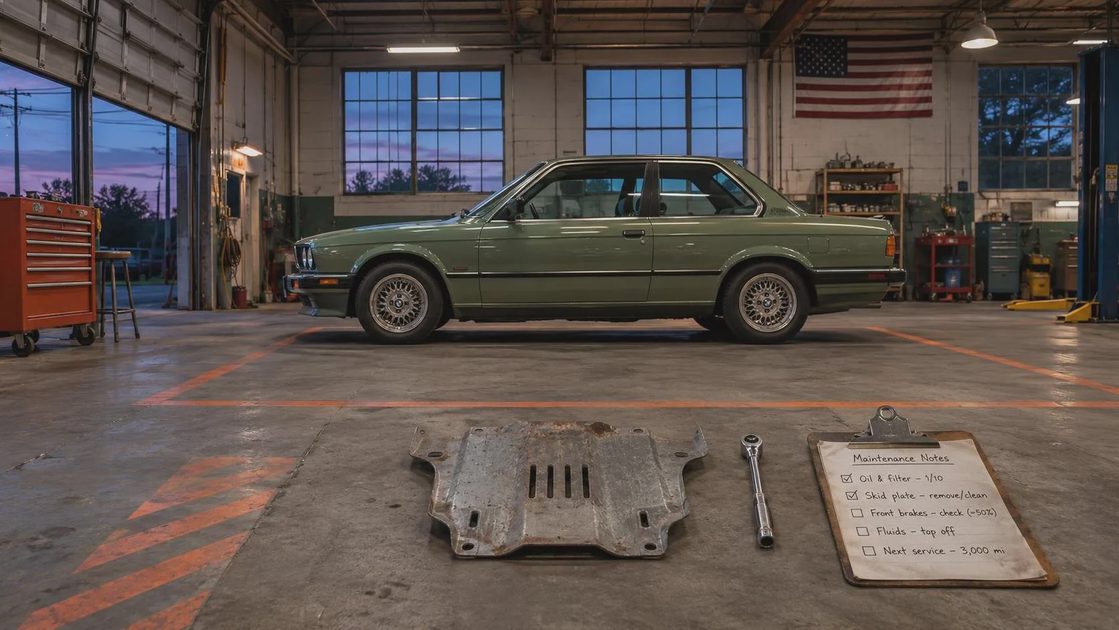
Test-fit the e30 skid plate with the car safely supported on stands placed at proper structural points. Never crawl beneath a vehicle held only by a floor jack. Clean the mounting areas first, chase rusty threads with the correct tap, and replace damaged fasteners before the plate goes on. If the kit uses rivet nuts, install them carefully and verify that they are fully seated; a spinning insert turns a simple removal into a frustrating drilling job.
Leave enough clearance around brake lines, fuel lines, wiring, steering joints, and exhaust tubing. A minimum of several millimeters is a sensible starting point, but heat shields or larger gaps may be needed near the exhaust. Use rubber isolators only where they will not allow excessive movement. Metal-on-metal contact can create a constant buzz, especially around the transmission tunnel.
Torque fasteners evenly rather than tightening one corner completely before the others. The correct torque depends on bolt diameter, grade, and whether the threads are dry or lubricated, so use the kit instructions or a fastener chart instead of guessing. After the first drive, inspect every mount, look for fresh contact marks, and retighten as needed.
Common mistakes and better alternatives
The cheapest e30 skid plate is not always the lowest-cost solution. A flat sheet with poorly positioned holes can reduce clearance, trap mud, and bend into the oil pan after one hit. A very heavy plate can also overload small brackets. Spend money on formed edges, strong mounts, countersunk or protected hardware, and a finish that can be repaired after scraping.
Do not use the plate as a substitute for correct suspension height. If the car regularly bottoms out, address spring rates, bump stops, alignment, and tire size first. The protection should be a second layer of defense, not a wear surface designed to drag over every driveway. On a street E30, a compact front plate may be enough. On a gravel build, combine broader coverage with mud clearance and easy cleaning.
Some builders fabricate their own e30 skid plate from cardboard templates, 1/8-inch steel, or 3/16-inch aluminum. That can work well when the car has unusual swap parts, but the template must account for chassis flex, drain access, and bracket load paths. A plasma cutter and welder do not replace careful measurement under the actual car.
Final checks before you drive
A finished e30 skid plate should sit tight, clear moving parts, and remain removable. Turn the steering from lock to lock while inspecting the plate and front suspension. Check clearance at full compression if you can do so safely, then inspect after a short drive over normal pavement. Listen for rattles during acceleration, braking, and low-speed turns.
The right choice depends on the build rather than the badge. A clean street car benefits from light coverage and easy service. A lowered track car needs careful clearance and strong mounting. A gravel or winter project deserves more complete protection and a finish that can handle repeated impacts. Document the measurements, hardware, and any modifications in your build thread so the next version of the car does not repeat the same late-night mistakes.
An e30 skid plate is a small part with a practical job: protect expensive components while preserving the character of the chassis. Choose the material deliberately, confirm the fitment around your actual engine and exhaust, and inspect the mounts after installation. Post your build. We'll read the whole thing.

No comments yet.